Oct 27, 2026Skincare & Personal Care
How Glass Bottles Are Packed for Export: A Buyer's Guide to Avoiding Breakage
Carton specs, foam and PVC inserts, pallet rules and receiving inspections — how wholesale buyers spec export packing so glass bottles arrive intact.
Nobody queries "export carton specifications" until the first shipment arrives with a drawer of shattered amber bottles. Then it becomes the only topic. Breakage in transit is almost never bad luck — it is a packing specification that was never written down, or written by nobody who lifts cartons for a living.
This guide is the checklist we wish every buyer sent before their first order: how export glass packing actually works, what to demand from your supplier, and how to receive a container so that any damage is documented while it still counts.
The three layers of export packing
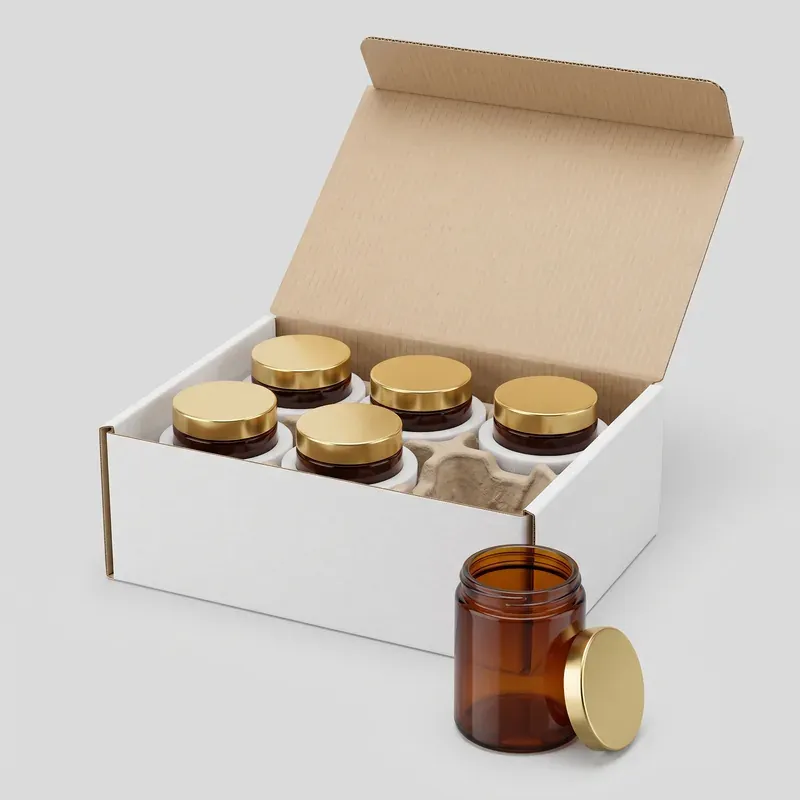
[IMAGE PLACEHOLDER 1: Open export carton showing PS foam insert cells each holding one amber bottle, half-packed. To be replaced with a real photo before publishing.]
Layer 1 — Individual protection (inside the carton).
Each bottle or jar is separated from its neighbors. The standard options:
– Polystyrene (PS) foam inserts — molded cavities, one bottle per cell; the default for glassware export and the strongest option for fragile shapes.
– PVC trays/inserts — clear plastic dividers; lighter and cheaper than PS foam, common on straight-sided bottles and jars.
– Paper partitions — the budget tier; acceptable on sturdy jars with generous carton fill, risky on long-neck bottles.
As a manufacturer we offer color box, PS foam and PVC packing as standard options (custom packaging from 5,000 pcs) — and we recommend buyers treat the insert choice as part of the specification, not an afterthought.
Layer 2 — The export carton.
The inner carton is what survives the forklift. The two specs that matter:
– ECT (edge crush test) rating — roughly: heavier glass needs higher ECT. A carton that is "strong enough" for plastics is not automatically strong enough for glass.
– Carton weight limit — a filled export carton for glass is typically kept in the 15–20 kg range so individual cartons remain liftable and stackable. Ask your supplier what their standard filled-carton weight is; an answer in kilograms means you are talking to someone who has loaded a container.
Layer 3 — Palletization and container loading.
For full-container orders: cartons stacked square-corner on pallets (or floor-loaded per agreed plan), stretch-wrapped, straps as needed, no voids — voids are where stacks shift and crush. For LCL (less-than-container) shipments, breakage risk rises because your cartons travel with other people's freight; if your first orders are LCL, say so explicitly so the packing is specced for it.
Retail-ready adds a layer
If cartons go straight to a warehouse, export packing is the only packing. If bottles ship as retail units (each bottle in its own color box), the color box becomes the individual protection layer — and it must be specced for transit, not just for looks. A beautiful rigid box with no internal grip lets the bottle travel; add a molded insert or shrink inner. Our custom packaging program (/contact) covers color boxes from 5,000 pcs, engineered jointly with the packing plan.
What to demand from any supplier (copy this into your PO)
1. Packing method per SKU: PS foam / PVC / paper, insert type and cell count per carton
2. Filled carton weight and dimensions per SKU (for your freight math)
3. ECT rating of the export carton
4. Pallet plan for FCL; confirmation that LCL orders get reinforced packing
5. Drop-test or packing-test evidence on request (who tested what, when)
6. Spares: agreed percentage of extra units per shipment to cover transit attrition
None of this is exotic — it is standard discipline. A supplier who answers all six lines in one reply runs a real export operation. (Ours ships across the USA, Germany, Canada, France, the UK, Sweden, Japan, the Netherlands and Belgium — per company profile — on exactly this checklist.)
Receiving: document damage while it still counts
[IMAGE PLACEHOLDER 2: Warehouse receiving scene: person photographing cartons on a pallet with a phone. To be replaced with a real photo before publishing.]
1. Photograph before opening: pallet condition, wrap, any crush or wet spots on cartons.
2. Open suspect cartons first, photograph damage with the carton label visible in frame.
3. Count and categorize: broken / chipped / scuffed are different claims.
4. File within the claim window — with your supplier and the freight forwarder. Photos from receiving are the entire evidence file; photos from next Tuesday are a mood board.
5. Feed it back into the spec: if one SKU broke and others didn't, the answer is usually that SKU's insert or carton, not "glass in general."
Breakage economics: why this checklist pays for itself
A typical stock order — say a pallet of 30 ml dropper bottles — carries a goods value where a 2–3% breakage rate costs more than every insert in the container. Packing that prevents one broken carton usually pays for itself in a single shipment. This is also why our in-stock program (/in-stock-products) ships on standardized, field-tested packing rather than per-order improvisation: the packing is part of the product.
And as always: test the whole chain once before scale — order a $39 refundable sample (/samples), then a small stock order, and inspect how it arrives. The sample proves the bottle; the first carton proves the packing.
FAQ
What percentage of glass breaks in shipping?
With proper export packing (foam/PVC inserts, spec'd cartons, palletized FCL), transit breakage is typically a low single-digit percentage or below; with no specification, it can run far higher. The variable is the packing discipline, not glass itself.
Is LCL shipping safe for glass bottles?
It can be, if the supplier knows it is LCL and reinforces packing accordingly — mixed-freight handling is rougher than dedicated container loading. Always declare the shipping mode when ordering.
Who pays for breakage — supplier or freight?
Depends on Incoterms and where the damage occurred; this is exactly why receiving documentation (photos with carton labels, filed in the claim window) matters for both claims.
Do you offer custom retail boxes with the bottles?
Yes — color box, PS foam and PVC packaging are standard options, with custom packaging from 5,000 pcs, specced together with the transit packing plan — contact us (/contact), we reply within one working day.
About SEALAND Packaging: Xuzhou SEALAND is a factory-and-trading combine exporting glass bottles and jars wholesale across nine countries in North America, Europe and Asia (company-stated), with in-house OEM/ODM, QC and standardized export packing programs.